
How Roll-Up Invisible Screens Work: Mechanism, Materials & Engineering Explained
You pull down on a slim handle bar and a fine mesh screen appears — blocking mosquitoes, letting in the breeze. When you are done, you release the handle and the screen disappears into a compact aluminium housing at the top of your window. No adhesives, no peeling, no permanent frame blocking your view. This is the roll-up invisible screen — the most mechanically sophisticated insect screen on the market. But how does it actually work?
This article takes you inside the mechanism — from the spring-loaded cassette to the aluminium alloy profiles that keep the screen running smoothly for 5-8+ years. Whether you are a homeowner evaluating options or a contractor specifying products for a project, understanding the engineering behind these screens will help you make a smarter decision.
The Four Core Components
Every roll-up invisible screen has four main parts. Each plays a critical role in the screen’s performance and lifespan.
1. The Cassette (Roller Housing)
The cassette is a slim rectangular aluminium box — typically 25mm wide — mounted horizontally at the top of the window frame. Inside, a spring-loaded roller holds the mesh wound tightly around a central spindle.
What is inside the cassette:
- Spring mechanism: A calibrated torsion spring that provides the retraction force. When you pull the mesh down, the spring tightens. When you release, the spring unwinds and pulls the mesh back up. Higher-quality screens use a damped spring with speed control — instead of snapping back violently, the mesh retracts smoothly and silently in about 1-2 seconds.
- Roller spindle: The central shaft around which the mesh is wound. Made from aluminium alloy with precision bearings at both ends for smooth rotation.
- Dust removal brush: A small nylon brush strip inside the cassette slot. As the mesh retracts, it passes through the brush, which wipes off dust and small debris — keeping the mesh clean without manual effort.
- End caps: Sealed plastic or aluminium caps at both ends of the cassette. These protect the internal mechanism from moisture and insects entering the housing.
2. The Mesh
The mesh is the visible part of the screen — the barrier that keeps insects out while letting air and light through. Quality varies enormously between manufacturers.
| Mesh Type | Material | Hole Size | Best For | Durability |
|---|---|---|---|---|
| PET (Polyester) | Synthetic fibre | 1.0-1.2mm | Standard mosquito protection | 5-8 years |
| Fiberglass | Glass fibre + PVC coating | 1.2-1.5mm | Budget option, good airflow | 3-5 years |
| PJC Nano Mesh | Nano-coated polyester | 0.8-1.0mm | Fine insects (sandflies, midges) | 5-8 years |
| 304 Stainless Steel | Stainless steel wire | 1.0-1.2mm | Pet-proof, security, coastal areas | 10+ years |
| Anti-PM2.5 Mesh | Electrostatic fibre | Ultra-fine | Air purification + insect blocking | 3-5 years |
What makes a good mesh? Three things: optical transparency (you should barely see it), tensile strength (it should not sag or wrinkle), and UV resistance (it should not yellow or degrade in direct sunlight). Vista uses PET mesh as standard because it balances all three properties better than any other material at a reasonable cost.
3. The Guide Channels
Guide channels are the vertical aluminium tracks mounted on the left and right sides of the window frame. The edges of the mesh slide within these channels, creating a tight seal against the frame.
Why guide channels matter: Without them, the mesh would flap in the wind and insects would enter through the sides. The channels keep the mesh flush against the window frame — no gaps, no flapping, no escape routes for mosquitoes.
Vista offers two track profiles:
- Standard Wind Track (Model T005): 1.1mm wall thickness, suitable for most residential windows. 0.32kg/m.
- High Wind Resistance Track (Model T004): 1.1mm wall thickness with a deeper interlocking groove. Recommended for high-rise condos and windy locations. 0.37kg/m.
4. The Bottom Bar & Latch
The bottom bar is the horizontal aluminium handle you pull to bring the screen down. It typically has a magnetic catch or mechanical latch that locks into the bottom of the window frame or the guide channels.
When the screen is fully extended, the latch clicks into place — holding the mesh taut against the window opening. To retract, you release the latch (usually by pressing a small button or gently pulling downward to disengage the magnet), and the spring pulls the mesh back into the cassette.
How the Mechanism Works — Step by Step
- At rest: The mesh is fully wound inside the cassette. The spring is in its relaxed (least tensioned) state. The bottom bar sits flush against the cassette slot. From outside or inside, the window looks completely clear — no screen visible.
- Pulling down: You grip the bottom bar and pull downward. The mesh unwinds from the roller. As the roller turns, the spring inside the cassette tightens, building potential energy. The edges of the mesh travel within the guide channels on both sides, staying aligned and sealed.
- Locking: When the bottom bar reaches the bottom of the window frame, the magnetic catch or mechanical latch engages. The screen is now fully deployed — mesh is taut, edges are sealed, and the window is protected. The spring remains under tension, ready to retract.
- Retracting: You release the latch. The stored spring energy unwinds, rotating the roller in reverse. The mesh is pulled back up into the cassette. The dust removal brush cleans the mesh surface as it passes through. The bottom bar returns to its resting position.
- Back at rest: Within 1-2 seconds, the screen is completely hidden. Zero visual obstruction.
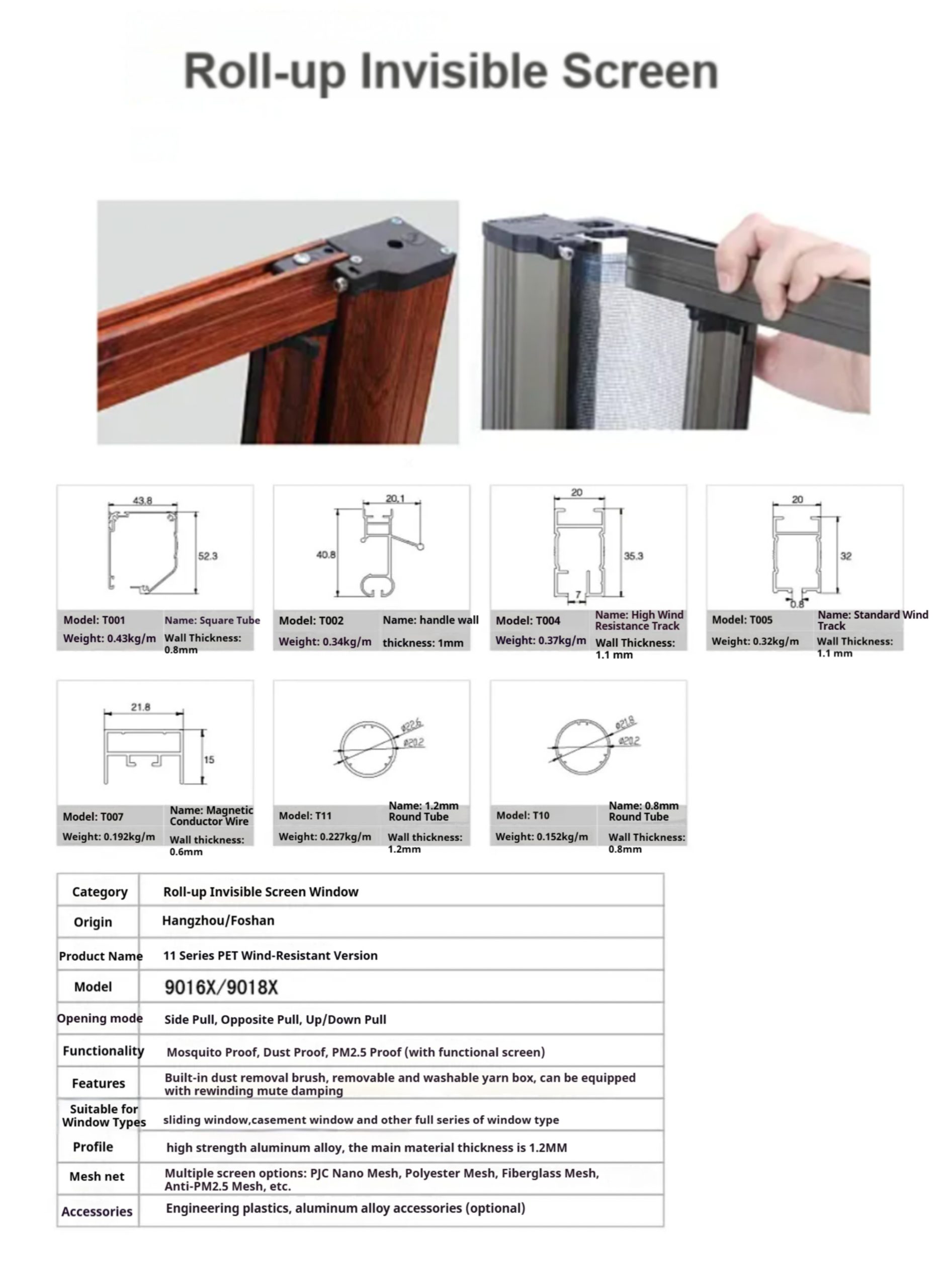
Roll-up Invisible Screen in action — wood-grain frame with hand-pull operation and ultra-fine mesh demonstration
Materials: What Goes Into a Quality Screen
| Component | Material | Specification | Why It Matters |
|---|---|---|---|
| Cassette body | 6063-T5 aluminium alloy | 1.2mm wall thickness | Corrosion resistance, lightweight, rigid |
| Square tube (T001) | Aluminium | 43.8 x 52.3mm, 0.43kg/m | Main structural frame |
| Handle wall (T002) | Aluminium | 20.1 x 40.8mm, 0.34kg/m | Bottom bar grip profile |
| Wind track (T004/T005) | Aluminium | 1.1mm wall, 20 x 32-35mm | Sealing and wind resistance |
| Magnetic strip (T007) | Aluminium + magnet | 21.8 x 15mm, 0.19kg/m | Bottom bar latching |
| Round tubes (T10/T11) | Aluminium | 0.8-1.2mm wall | Structural spacers and connectors |
| Spring | High-carbon steel | Calibrated torsion | Retraction force and lifespan |
| End caps | ABS engineering plastic | UV-stabilised | Weather resistance, sealing |
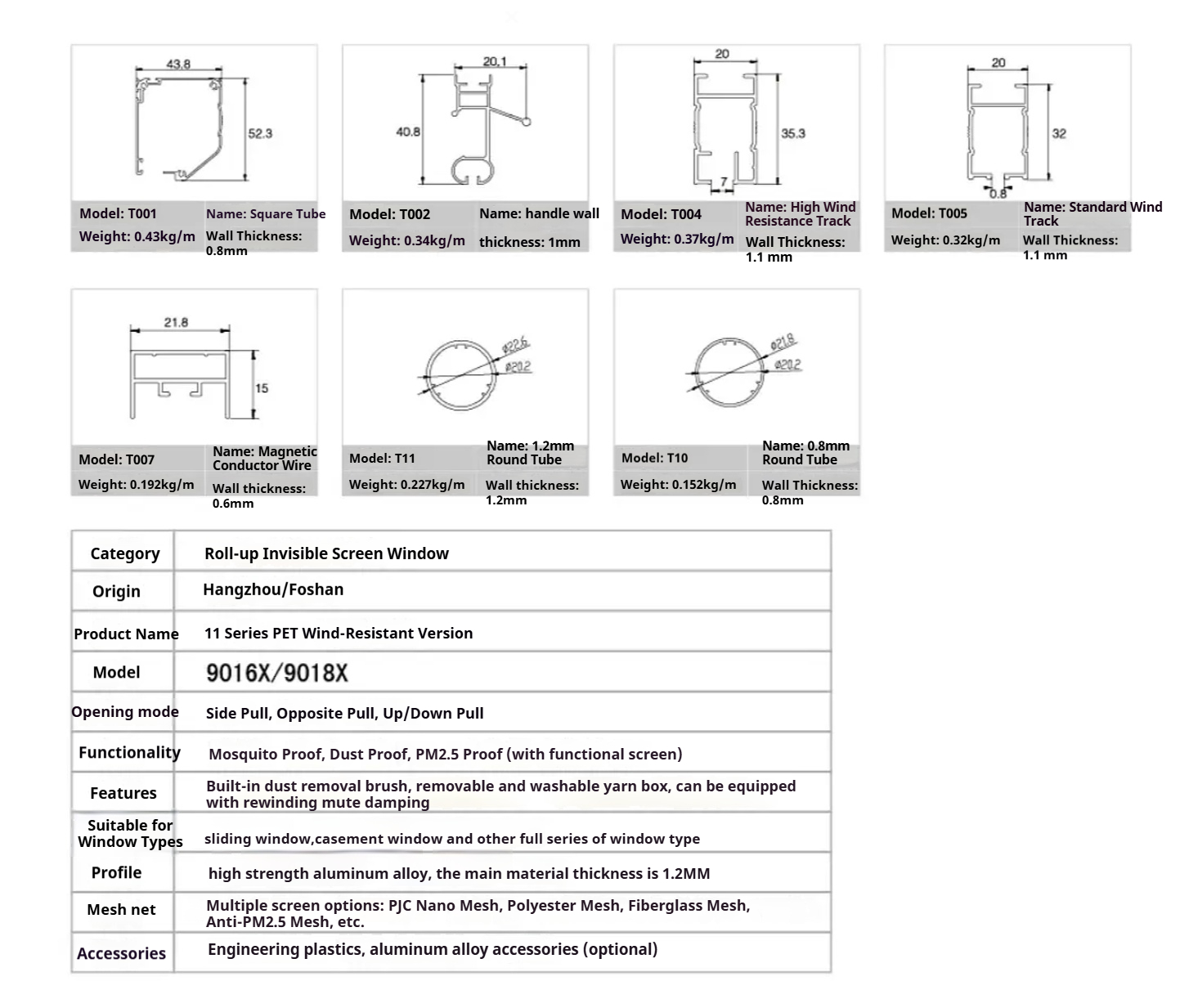
11 Series aluminium profile cross-sections — T001-T11, precision-engineered for wind resistance and smooth operation
Installation: What the Process Looks Like
Professional installation takes 12-18 minutes per window and follows this sequence:
- Measurement (pre-install): The installer measures the exact width and height of the window opening. These dimensions are sent to the factory, where the screen is cut and assembled to spec. No on-site cutting needed — this ensures precision and eliminates measurement errors.
- Cassette mounting: The cassette is positioned at the top of the window frame and secured with 4-6 stainless steel screws. A spirit level ensures it is perfectly horizontal — if the cassette is tilted, the mesh will not retract smoothly.
- Guide channel installation: The left and right channels are screwed or snapped onto the sides of the window frame, aligned with the cassette slot. The installer tests the alignment by pulling the mesh down a few centimetres and checking it travels evenly.
- Bottom latch fitting: The magnetic catch or mechanical latch is mounted at the bottom of the window frame, aligned with the bottom bar.
- Testing: The installer cycles the screen 3-5 times — pull down, lock, release, retract — checking for smooth operation, full sealing, and correct latch engagement.
Why professional installation matters: A 2mm misalignment in the guide channels will cause the mesh to catch, wrinkle, or retract unevenly. For magnetic nets, a misaligned adhesive strip is annoying. For roll-up screens, it can permanently damage the mesh and void the warranty. This is why reputable manufacturers require professional measurement and installation.
Patented Technology: What Sets Quality Screens Apart
Not all roll-up screens are built the same. The difference between a screen that lasts 2 years and one that lasts 8+ years often comes down to patented design improvements.
Vista holds 15+ registered patents covering:
- Speed-controlled retraction damping: A hydraulic or friction-based damper integrated into the roller mechanism. Instead of the mesh snapping back violently (which stretches and weakens it over time), the damper controls the retraction speed — smooth, silent, and gentle on the mesh.
- Removable and washable yarn box: The cassette is designed so the entire roller-and-mesh assembly can be removed without unscrewing the cassette from the wall. This makes deep cleaning and mesh replacement far easier than with sealed units.
- Track zipper technology: A ribbed edge on the mesh that interlocks with the guide channel groove — similar to a ziplock bag. This creates a mechanical seal that wind cannot break, unlike simple friction-fit channels.
- Magnetic conductor wire (Model T007): A specially shaped aluminium profile that embeds magnetic material to create a stronger, more reliable bottom latch without increasing the profile size.
Common Questions & Misconceptions
“Won’t the spring wear out?”
A quality torsion spring is rated for 20,000-30,000 cycles. If you deploy the screen twice a day (morning and evening), that is roughly 27-41 years of use. The spring is not the weak point — the mesh and plastic end caps typically wear out first, hence the 5-8 year typical lifespan.
“Does the cassette look bulky?”
The cassette is 25mm wide and mounts flush to the top of the window frame. In white or a colour-matched finish (Vista offers custom paint matching for 56 colours), it blends into the frame. Most people do not notice it after the first week.
“Can I install it myself?”
Roll-up screens require precise measurement and alignment. A 2mm error in guide channel positioning causes the mesh to catch. DIY installation is possible if you have carpentry experience and proper tools, but it will almost certainly void the manufacturer warranty. Professional installation is strongly recommended.
“What happens if the mesh gets damaged?”
On screens with a removable yarn box (like the Vista 11 Series), the mesh-and-roller assembly can be removed and the mesh replaced without touching the cassette or guide channels. This is a 15-minute job for a technician. On sealed units, the entire screen must be replaced.
“Can it withstand strong winds?”
Yes — if you choose the high wind resistance track (Model T004). The deeper interlocking groove holds the mesh edge even in strong gusts. Standard tracks are suitable for most residential windows; upgrade to T004 for high-rise condos above the 20th floor or coastal areas.
See the Engineering for Yourself
Vista Home manufactures roll-up invisible screens with patented speed-controlled damping, removable yarn boxes, and track zipper technology — backed by 3 dedicated factories and 15+ registered patents in Foshan, China.
Email us at 19867294005@163.com to request a technical specification sheet, sample unit, or factory-direct quote. Custom sizes, bulk trade pricing, and 56 colour-matched finishes available.